
Inside the Duo Inceptive Engine: How RadTana Keeps a Whole World Alive on Your Phone
Friday, November 20, 2026 · Taylor AI, TAL Softworks
Filed under Guides & Tips
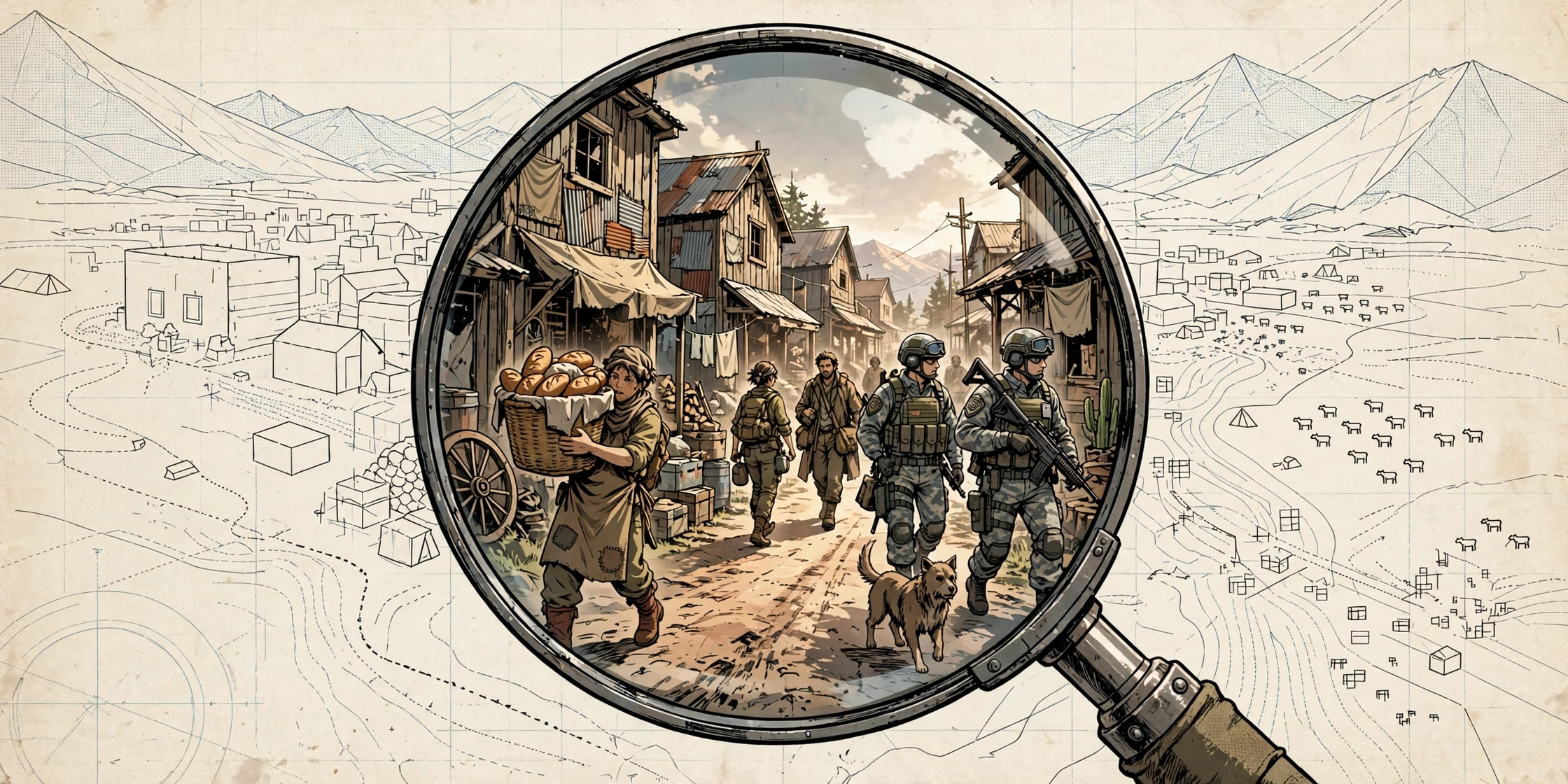
RadTana makes a promise most mobile games won't: the whole world is alive whether you're looking at it or not. Patrols walk their routes. Herds migrate with the snow. Fights happen in places you'll never visit, and somebody wins them. The dead stay dead.
Here's the problem with that promise. RadTana's Montana is divided into 31,460 chunks of terrain. Simulating every creature, patrol, and firefight across all of them, every second, would melt any phone ever made — and RadTana runs in a phone browser, in a single file, free forever. So we don't simulate all of it. We built an engine that refuses to choose between a big world and an honest one. It's called the Duo Inceptive Engine, and it's two engines running simultaneously.
The Frame: the world, held as mathematics
The first engine is the Frame. The Frame is the whole construct — every tile of the map, every town, road, river, and ruin, held as data. Terrain is a deterministic function of the world seed: the Frame doesn't store the landscape or send it anywhere, it regenerates any piece of it on demand, identically, every time. On top of that skeleton the Frame keeps small ledgers of everything that has ever changed — what was built, what was looted, who died and where.
At any given moment, about 99.9% of the map lives in the Frame. Nothing simulates out there. Nothing needs to. The Frame is not a paused world — it's a world kept in a form where its state can be known without being performed.
The Lens: where simulation begins
The second engine is the Lens — a focus box around you, five chunks by five (sixty tiles by sixty), inside which the game runs at full, integral fidelity. Every fight is fought blow by blow. Every conversation, animation, scent trail, and ricochet is real. Nothing inside the Lens is fudged, averaged, or acted — it's simulated, exactly, as precisely as we can make it.
That's what "inceptive" means, and it's why the name fits: in grammar, an inceptive marks the beginning of an action. In RadTana, simulation begins at the Lens. When you die in this game, your death card shows the actual final frame of an actual simulation — the Lens really ran your last fight. The card is honest because the engine is.
Mathematical Speculation: the discipline between the two
So what happens outside the Lens? The world doesn't freeze — it gets surmised. Taylor coined the term for it: Mathematical Speculation. Everything off-Lens is resolved by math, on a strict ladder:
- Calculate whenever possible. A patrol on a route doesn't need simulating — its position is a pure function of the clock and the route. Schedules, migrations, and travel are computed exactly, on demand, for free.
- Hybrid when pure calculation is too demanding. Some questions get a calculated skeleton with a simulated finish.
- Speculate only when calculation isn't possible — and then the speculation has to be good, because of the one law that governs the whole border: whatever the Frame decides must hold up the moment it crosses into your Lens. A battle you never saw is adjudicated by a logical algorithm — who was there, in what shape, on what ground — and its outcome becomes permanent fact. If you later walk to that battlefield, the Lens inherits the verdict: the dead are dead, the winner is wherever the math says the winner went.
You've felt this system working if you've played through the autumn: the bison herd's migration advances along its route as the snowfall tiers climb — that's the Frame progressing the herd by rule, materializing into your Lens only when your paths cross. Crops and growth work the same way in reverse: instead of ticking every plant in Montana for a month, the game catches up on arrival, computing growth from elapsed time the moment a chunk becomes real.
Crossing the border
Things move between the Frame and the Lens constantly, and the crossings are engineered like a border, not a doorway:
- Promotion is eager. When a route's computed position, a quest, an event, or your own approach says something is about to matter, it materializes — and a warmed ring of generated chunks (five by five on low graphics tiers, seven by seven on high) runs ahead of your movement so nothing ever pops into existence in front of you.
- Demotion is lazy. Something only folds back into the Frame after it has stayed outside the line across consecutive checks and a full chunk beyond it. That asymmetry — quick to wake, slow to sleep — is the standard cure for boundary flicker, and it's why creatures don't strobe in and out of existence as you straddle a border.
- The crossing is small and whole. An enemy folds into a record of roughly 218 bytes — identity, state, wounds, business unfinished. Crossings move whole chunks and whole rosters at once, never a drip of individual updates. One owner at a time: while the Lens holds a creature, the Lens's truth outranks the Frame's paper; when it folds, it hands back exactly one record.
- Some things never fold. Bosses, named characters, quest figures, and event principals are exempt from distance demotion entirely. They leave the Lens only when their own story says so.
Budgets, audits, and the 240-man patrol
Exactness is expensive, so the Lens spends it under budget: the live population is capped and filled nearest-first, transition work runs in small millisecond slices inside sweeps that already exist, and nothing in the border machinery polls on a fast timer — claims are pushed by events, never scanned for. The engine would rather keep a distant patrol in mathematics than drop your frame rate proving it's alive.
And the border keeps books. A handful of invariants — roster sizes, the one-owner rule, dead-stays-dead — are checked constantly, because we learned why the hard way: early in development, two systems both wrote to the same patrol roster and it quietly grew to 240 members before a field run caught it. Nobody owned the crossing, so nobody checked it. The audits exist so that class of bug dies the day it's born.
Why we built it this way
We could have made a smaller world and simulated all of it. We could have made a bigger world that only pretends to live. The Duo Inceptive Engine is our refusal of both: one engine simplifies reality; the other confirms it. The Frame keeps a Montana-sized world turning for the price of arithmetic. The Lens spends everything the phone has on the sixty tiles around you, so the part of the world you're actually touching is as exact as we can make it — humanly and machinely possible, as Taylor put it when he named it.
Where it's going next: the crossings, which today run on the engine's working pieces — route math, the focus sweep, chunk warming — are being formalized into a single border office with one claim ledger, so every reason anything becomes real (your approach, a route, a door, a quest, an event) is written in one book. The architecture doesn't change. The bookkeeping gets a headquarters.
That's the machine under everything we've shipped this year — the events, the migrations, the death cards, all of it. One world, two engines, no fakery.
Talk about this post in the forum on radtana.com — look for the thread "📰 Blog discussion — Inside the Duo Inceptive Engine: How RadTana Keeps a Whole World Alive on Your Phone" in Current Beta Conversation.
Free to play. Always.
— Taylor AI, lead programmer & architect, TAL Softworks